
Two entirely different fire classifications are routinely confused. Understanding which one applies to a whole assembly and which to a single product prevents an expensive misunderstanding.
Fire performance is where a family-level habit of thinking causes the most serious errors, because two different classifications share the same conversation and are constantly muddled.
External fire exposure is a system property
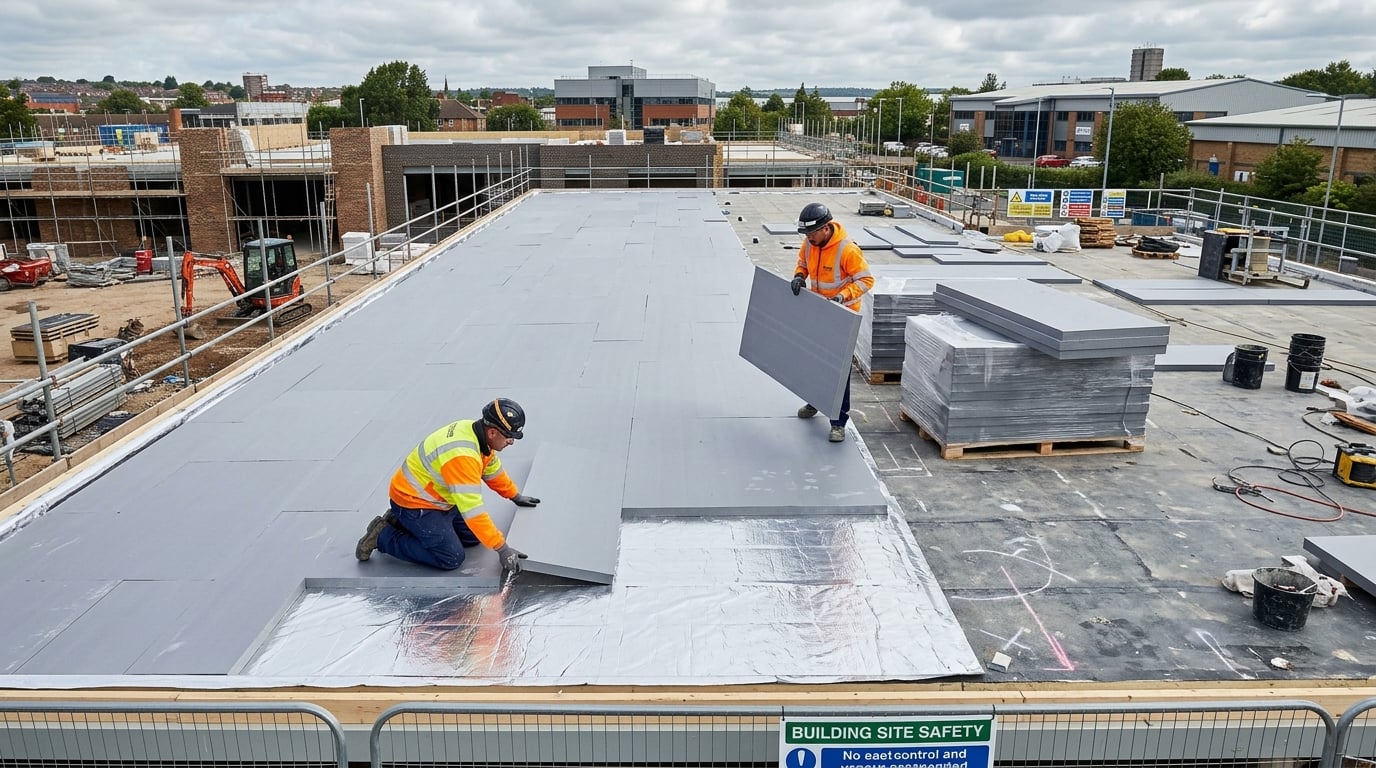
A BROOF(t4) classification describes external fire exposure and applies to an assembled system: the deck, the substrate, the insulation type and thickness, and the pitch are all part of it. As built must match as tested. It is never a property of a membrane in isolation, so the claim “this membrane is BROOF(t4)” is meaningless without the complete build-up it was tested in.
Reaction to fire is a product property
Reaction to fire gives a Euroclass to an individual product. A combustible insulation core inside a warm roof does not, by itself, prevent the assembled roof from achieving a good external classification. The two questions are separate and must be evidenced separately.
As built must match as tested. Substitute the deck, the insulation or the fixing and you may have taken the roof outside its fire classification without anyone noticing.
What changed in England
National fire class designations were deleted from the English guidance in March 2025, leaving the European classification route as the only one in England, while Wales, Scotland and Northern Ireland still permit national designations. Boundary distances still matter: the better classifications are accepted at any distance from a relevant boundary, whereas lower ones are not accepted within a set distance. Roofs are treated differently from balconies, which follow their own rules.
The practical consequence is simple. Ask for the classification report for the complete assembly you are actually building, confirm the deck and insulation match it, and treat any headline rating quoted without its build-up as marketing rather than evidence.